Back
AIDS and HIV
AIDS
AIDS (Acquired Immune Deficiency Syndrome) is a medical condition. People develop
AIDS because HIV has damaged their natural defences against diseases.
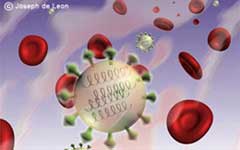
HIV (Human Immunodeficiency Virus)
HIV is a virus. Viruses infect the cells that make up the human body and replicate
within those cells. A virus can also damage human cells, which is one of the things
that can make a person ill.
HIV can be passed from one person to another. A person can become infected with
HIV through contact with the body fluids of someone who already has HIV. HIV stands
for the 'Human Immunodeficiency Virus' and the one who is diagnosed as infected
with HIV is said to be 'HIV+' or 'HIV positive'.
The immune system is a group of cells and organs that protect your body by fighting
disease. The human immune system usually finds and kills viruses fairly quickly.
So if the body's immune system attacks and kills viruses, what's the problem?
Different viruses attack different parts of the body - some may attack the skin,
others the lungs, and so on. The common cold is caused by a virus. What makes HIV
so dangerous is that it attacks the immune system itself - the very thing that would
normally get rid of a virus. It particularly attacks a special type of immune system
cell known as a CD4 lymphocyte.
HIV evades the body's defences and mutates rapidly. This means that once HIV has
taken hold, the immune system can never fully get rid of it.
There isn't any way to tell just by looking if someone's been infected by HIV. In
fact a person infected with HIV may look and feel perfectly well for many years
and may not know that they are infected. But as the person's immune system weakens
they become increasingly vulnerable to illnesses, many of which they would previously
have fought off easily.
The only reliable way to tell whether someone has HIV is for them to take a blood
test, which can detect infection.
When HIV causes AIDS
A damaged immune system is not only more vulnerable to HIV, but also to the attacks
of other infections. As time goes by, a person who has been infected with HIV is
likely to become ill more and more often until, usually several years after infection,
they become ill with one of a number of particularly severe illnesses.
It is at this point in the stages of HIV infection that they are said to have AIDS
- when they first become seriously ill, or when the number of immune system cells
left in their body drops below a particular point. Different countries have slightly
different ways of defining the point at which a person is said to have AIDS rather
than HIV.
AIDS is an extremely serious condition and at this stage the body has very little
defence against any sort of infection.
How long does HIV take to become AIDS?
Without drug treatment, HIV infection usually progresses to AIDS in an average of
ten years. This average, though, is based on a person having a reasonable diet.
Someone who is malnourished may progress to AIDS and death more rapidly.
Antiretroviral medication can prolong the time between HIV infection and the onset
of AIDS. Modern combination therapy is highly effective and, theoretically, someone
with HIV can live for a long time before it becomes AIDS. These medicines, however,
are not widely available in many poor countries around the world and millions of
people who cannot access medication die.