Back
Bleaching And Whitening Agents
Bleaching
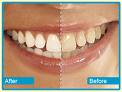
Dental bleaching also known as tooth whitening, is a common procedure in general
dentistry but especially in the field of cosmetic dentistry. A child's deciduous
teeth are generally whiter than the adult teeth. As a person ages the adult teeth
often become darker due to changes in the mineral structure of the tooth, as the
enamel becomes less porous. Teeth can also become stained by bacterial pigments,
foodstuffs and tobacco. Certain antibiotic medications (like tetracycline) can also
lead to teeth stains or a reduction in the brilliance of the enamel.
There are two methods to whiten teeth-bleaching gel and laser bleaching. Traditionally,
at-home whitening is done with bleaching gel which is applied to the teeth using
thin guard trays. Oxidizing agents such as hydrogen peroxide or carbamide
are utilised to lighten the shade of the tooth. The oxidizing agents oxidize the
porosities in the rod-like crystal structure of interprismatic stain deposits; over
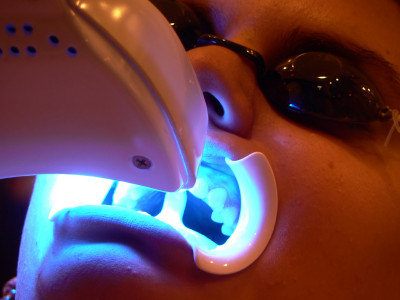
a period of time, the dentin lying underneath the enamel is also bleached. Laser
bleaching utilizes light energy to accelerate the process of bleaching in a dental
clinic. The effects of bleaching can last for several months, but may vary depending
on the lifestyle of the patient. Factors which will decrease whitening include smoking
and the ingestion of dark coloured liquids like coffee, tea and red wine.
Internal staining of dentin can discolour the teeth from inside out. Internal bleaching
can remedy this. If heavy staining or tetracycline damage is present on a patient's
teeth and whitening is ineffective, there are other methods of whitening teeth.
Bonding, when a thin coating of composite material is applied to the front of a
person's teeth and then cured with a blue light. This can be performed to mask the
staining. A veneer can also mask tooth discolouration.
The mechanism of bleaching involves free radicals and breakdown of pigment whereas
whitening is accomplished by abrasive action as in dentrifices. Tooth bleaching
agents may be used for external or internal bleaching performed in the clinic by
a dentist or at home by a patient.
Internal bleaching
Internal bleaching procedures are performed on devitalized teeth that have undergone
endodontic therapy but are discoloured due to internal staining of the tooth structure
by blood and other fluids. Unlike external bleaching which brightens teeth from
the outside in, internal bleaching brightens teeth from the inside out. Bleaching
the tooth internally involves drilling a hole into the pulp chamber, cleaning, sealing
and filling the root canal with a rubber- like substance, and placing a peroxide
gel into the pulp chamber so that the gel can work directly inside the tooth on
the dentin layer. Internal bleaching is always performed in the dental clinic. Seldom
produces reliable results when used to eliminate intrinsic stains in dentin. There
are two common approaches to internal bleaching:
- Office bleach: The agent here is a mixture of 30% to 35% hydrogen peroxide and sodium
perborate which is heated to accelerate the process of bleaching.
- Walking bleach: A mixture of hydrogen peroxide and sodium perborate are sealed to
the tooth for 2-3 days .
Mechanism of action: Sodium perborate powder decomposes into sodium
metaborate and hydrogen peroxide thus releasing nascent oxygen. The sodium perborate
powder that is mixed with hydrogen peroxide also releases nascent oxygen. This combination
is thought to be synergistic and very effective in bleaching.
Side effects
- Chemical burns with gel bleaching (if a high-concentration oxidizing agent contacts
unprotected tissues, which may bleach or discolour mucous membranes).
- Sensitive teeth and overbleaching (known in the profession as "over white teeth"
or "Hyperodonto-oxidation").
- Rebound or teeth losing the bleached effect and darkening, is also an issue, showing
the rebound effect over 30 days.
Extrinsic bleaching
Is indicated for teeth that are discoloured from ageing, fluorosis or tetracycline
staining. It can be applied by the dentist or by the patient. Dentist applied bleaching
can be divided into:
- Power bleach with high concentrations of hydrogen peroxide which are premixed gels
or liquid bleach with powder system that are mixed chairside. These products are
caustic and thus should be cautiously used .
- Assisted bleaching with high concentrations
of carbamide peroxide.
Indications for bleaching
|
Colour of Stain/ Etiology |
Ease or difficulty of bleaching |
|
Fluorosis |
Degree of difficulty depends on extent of fluorosis. |
|
Blue-grey |
|
Dentinogenesis imperfecta, erthroblastosis foetalis, tetracycline |
Deeply stained blue-grey discolourations, especially by tetracycline are more difficult
to treat than yellow stains. |
|
Yellow |
|
Fluorosis, physiologic changes due to ageing, obliteration of the pulp chamber |
Mild uniform yellow discolouration associated with ageing or mild uniform fluorosis
are the easiest to treat. |
|
Brown |
|
Fluorosis, caries, porphyra, tetracycline, dentinogenesis imperfecta |
Stains that are deeper in colour are difficult to treat. |
|
Grey |
|
Silver oxide from root canal sealers |
Dark stains from root canal sealers are seldom bleachable; should be treated restoratively. |
|
Black |
|
Mercury stains (amalgam), caries, fluorosis |
Very dark or black stains from silver- containing root canal sealers or from mercury
are seldom bleachable; should be treated restoratively. |
|
Pink |
|
Internal resorption |
Bleaching is not indicated; treatment consists of endodontics and calcium hydroxide. |
Possible interactions with bleaching agents
|
Beverages |
|
Coffee and tea |
May compromise with treatment results. |
|
Use of liquor |
May possibly result in additive carcinogenicity as peroxides have mutagenic potential.
It may also compromise in treatment. |
|
Tobacco |
|
Tobacco use |
May possibly result in additive carcinogenicity as peroxides have mutagenic potential.
It may also compromise in treatment. |
Precautions and adverse effects for bleaching
|
Precautions
|
Adverse efffects |
|
General
|
|
Patient should not smoke or use any kind of potential carcinogen |
Prolonged use of 30% or higher H2O2 can destroy cells and for cells that are not
destroyed prolonged use may increase the carcinogenic effect. |
|
Oral |
Patient with root sensitivity should avoid the treatment as it may aggravate sensitivity
In cases of tissue burns rinse the affected area for 1-5 mins |
Acidic nature of some products may produce transient dentin sensitivity. |
Teeth Whitening Systems
|
Whitening Agents |
 |
|
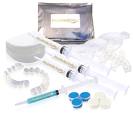
Various chemical and physical agents can be used to whiten teeth. Toothpaste typically
has small particles of silica, aluminum oxide, calcium carbonate or calcium phosphate
to grind off stains formed by coloured molecules that have lodged onto the teeth
from food. Unlike bleaches, whitening toothpaste does not alter the intrinsic colour
of teeth. Bleaching solutions contain peroxide which bleaches the tooth enamel to
change its colour. Off-the-shelf products typically rely on a carbamide peroxide
solution varying in concentration from 10% to 22%. Bleaching solutions may be applied
directly to the teeth, embedded in a plastic strip that is placed on the teeth or
use a gel held in place by a mouthguard. Because the concentration is less to avoid
toxicity, whitening often takes several weeks.
|
|
Whitening treatments used by dentists are much more concentrated, containing substances
with more than 30% hydrogen peroxide and require protection of the soft tissues.
|