Back
Central Government Ruling 1998
The Central government has via the Bio-Medical Waste (Management and Handling) Rules,
1998 notified the rules for the management and handling of biomedical waste in exercise
of the powers conferred by Sections 6, 8 and 25 of the Environment (Protection)
Act, 1986 on 20th July, 1998. These rules apply to all people who generate, collect,
receive, store, transport, treat, dispose or handle bio medical waste in any form.
Definition
In these rules unless the context otherwise requires. “Bio-medical waste" means
waste generated during the diagnosis, treatment or immunisation of human beings
or animals or in research activities pertaining there to or in the production or
testing of biologicals and including categories mentioned in Schedule I.
“Bio-medical waste treatment facility" means any facility wherein treatment of disposal
of bio-medical waste or processes incidental to such treatment or disposal is carried
out; "Occupier" is any institution generating bio-medical waste, which includes
a hospital, nursing home, clinic dispensary, veterinary institution, animal house,
pathological laboratory and blood bank. A person who has control over that institution
and/or its premises.
"Operator of a bio-medical waste facility" means a person who owns or controls or
operates a facility for the collection, reception, storage, transport, treatment,
disposal or any other form of handling of bio-medical waste; "Schedule" means schedule
appended to these rules.
Schedule I
Categories Of Biomedical Waste
|
Option Disposal
|
Waste Category
|
Treatment
|
|
Category No. I
|
Human Anatomical Waste (human tissues, organs, body parts).
|
Incineration /deep burial.
|
|
Category No. 2 |
Animal Waste (animal tissues, body parts, carcasses, bleeding parts, fluid,
blood and experimental animals used in research, waste generated by veterinary hospitals
colleges, discharge from hospitals, animal houses).
|
Incineration /deep burial.
|
|
Category No. 3 |
Microbiology and Biotechnology Waste (wastes from laboratory cultures, stocks or
specimens of micro organisms live or attenuated vaccines, human and animal cell
culture used in research and infectious agents from research and industrial laboratories,
wastes from production of biologicals,toxins, dishes and devices used for transfer
of cultures). |
Autoclaving, micro-waving, incineration.
|
|
Category No. 4 |
Waste sharps (needles, syringes, scalpels, blades, glass, etc. that may cause puncture
and cuts. This includes both used and unused sharps).
|
Chemical disinfection, autoclaving, microwaving, mutilation/ shredding.
|
|
Category No. 5 |
Discarded Medicines and Cytotoxic drugs (wastes comprising of outdated, contaminated
and discarded medicines and drugs).
|
Incineration/ destruction and disposal in secured landfills.
|
|
Category No. 6 |
Solid Waste (items contaminated with blood and body fluids including cotton, dressings,
soiled plaster casts, lines, beddings other material contaminated with blood).
|
Incineration/autoclaving/ Micro-waving.
|
|
Category No. 7 |
Solid Waste (wastes generated from disposable items other than the waste sharps
such as tubings, catheters, intravenous sets etc.).
|
Disinfection by chemical treatment/ autoclaving/ microwaving and mutilation/ shredding.
|
|
Category No. 8 |
Liquid Waste (waste generated from laboratory and washing, cleaning, house- keeping
and disinfecting activities.)
|
Disinfection by chemical treatment and discharge into drains.
|
|
Category No. 9 |
Incineration Ash (ash from incineration of any bio-medical waste).
|
Disposal in municipal landfills.
|
|
Category No. 10 |
Chemical Waste (chemicals used in production of Biologicals, chemicals used in disinfection
and as insecticides.)
|
Chemical treatment and discharge into drains for liquids and secure landfills for
solids.
|
Notes:
- Chemical treatment using at least 1% hypochlorite solution or any other equivalent
chemical reagent. It must be ensured that chemical treatment ensures disinfection.
- Multilation/shredding must be such so as to prevent unauthorised reuse.
- There will be no chemical pretreatment before incineration. Chlorinated plastics
shall not be incinerated.
- Deep burial shall be an option available only in towns with population less than
five lakhs and in rural areas.
Schedule II
Colour coding and type of container for disposal of Bio-Medical Wastes
|
Colour Coding
|
Type of Container -I Waste Category
|
Treatment options as per Schedule I
|
|
Yellow
|
Plastic bag Cat. 1, Cat. 2, Cat. 3 and Cat. 6.
|
Incineration/deep burial
|
|
Red
|
Disinfected container/plastic bag Cat. 3, Cat. 6, Cat.7.
|
Autoclaving/Microwaving/ Chemical Treatment
|
|
Blue/White translucent
|
Plastic bag/puncture proof Cat. 4, Cat. 7.
|
Autoclaving/Microwaving/ Chemical Treatment and destruction/shredding
|
|
Black
|
Plastic bag Cat. 5, Cat. 9 and Cat. 10 (solid). |
Disposal in secured landfill
|
Notes:
- Colour coding of waste categories with multiple treatment options as defined in
Schedule I, shall be selected depending on treatment option chosen, which shall
be as specified in Schedule I.
- Waste collection bags for waste types needing incineration shall not be made of
chlorinated plastics.
- Categories 8 and 10 (liquid) do not require containers/bags.
- Category 3 if disinfected locally need not be put in containers/bags.
SCHEDULE III
Label for Bio-Medical waste containers/bags.
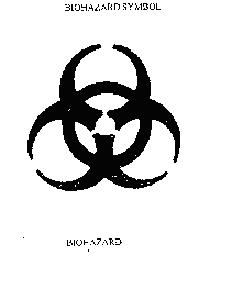
Handle with care.
Note : Label shall be non-washable and prominently visible.