|
Gums begin to bulge, and bleeding worsen protrude around teeth red from irritation
periodontal disease can occur
|
Gums begin to turn darker red from irritation Gums are more tender and bleed easily
|
Swelling continues and teeth can be obscured
|
Swelling
|
Causes
Improve your brushing technique or brush more frequently after eating to not only
eliminate bacteria, but the leftover food particles and sugary residues that feed
them. It only takes a couple of hours for bacteria to form plaque and only a couple
of days for that plaque to harden into tartar. Swollen gums can originate from number
sources, the most common of which are infection from a virus or fungus, Gingivitis,
poorly fitting dentures, side effect of
medication, malnutrition, Vitamin C deficiency (scurvy) and bacteria buildup.
Receding Gums
Gum recession occurs when bacteria in the mouth bond and form plaque, this irritates
and inflames the gums. As this worsens, the plaque can drive a wedge between the
teeth and gums. When this happens, the gum tissue can be eroded away by the waste
that these bacteria produce, causing a recessed appearance.
Progression of receding gums
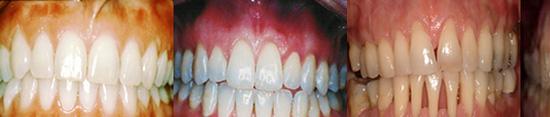
Pink Roots visible Tight to teeth Temperature sensitivity
• Scalloped appearance Tooth loss around each tooth
|
Swollen
Bleeding
Bright red
Tender to touch
|
Gums pull away from teeth
Loose teeth
Pus between teeth and gums
|
Dangers
While receding gums can be a sign of more serious gum conditions on the horizon,
they can also be a warning sign for some very serious health issues that many people
would never consider to be linked to gum issues. Directly, receding gums can lead
to teeth loosening or becoming crooked because of the tissue that holds the gum
in place is slowly moving away from the tooth. However, that is not the only danger
associated with receding gums. Indirectly, receding gums can act as a gateway to
serious conditions such as periodontal disease, which is proven to be linked to
much more serious conditions that include heart disease, heart attack, stroke, diabetes,
respiratory disease and lastly premature and underweight babies. Taking care of
receding gums is very important to maintain your body's overall health.
Bleeding Gums
Bleeding gums can be a precursor to serious conditions like gingivitis and periodontal
disease. If your gums bleed when you brush your teeth, you could be on the way towards
some very severe situations that have been proven to increase the risk of cardiovascular
disease, diabetes, stroke, HIV and more. If your gums are swollen or bleed, then
your entire circulatory system is open to the attack of every form of bacteria that
is present in your mouth.
Symptom
Bleeding gums can be a result of gum disease as previously mentioned, but it can
also be a symptom accompanying canker sores or mouth ulcers which have their own
causes aside from gum disease. If bleeding occurs due to a sore in the mouth you
will likely notice that the gums are sore and these can come as single sores or
in multiples. Signs that may indicate gum disease or gingivitis may include the
following sore gums, swollen gums, changes in the way teeth fit together , formation
of deep pockets between the teeth and gums, gums that bleed during and after brushing
teeth , loose, or shifting teeth and receding gums
Progression of bleeding gums
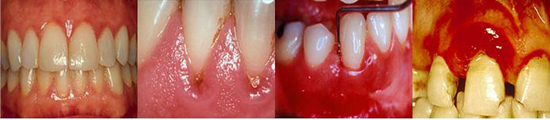
|
Gums begin to darken recede to severe levels from light pink to red when Bleeding
occursand there is more bloodBleeding after or during brushing
|
Bleeding occurs
on its own,brushing
|
Gums begin to
recede and bleed
more frequently
more regularly
|
Gums not just |
Dangers
Bleeding gums can often lead to gum disease. If there is a passageway for blood
to exit your tissue, it makes sense that vice- versa harmful bacteria that are formed
in the mouth can gain access to your bloodstream and cause health problems. Some
of the dangers that can eventually take place are digestive system disorders, respiratory
problems, higher risk for heart attack or stroke, diabetes and pancreatic cancer.CauseBacteria
in the mouth can easily grow out of control when proper oral hygiene is not being
practiced. When this happens, the bacteria form plaque and eventually tartar. This
causes inflammation of the gums, along with swelling and bleeding. Bleeding can
also occur as a result of improper flossing. Be careful to allow the floss to slide
along the natural curves of the teeth and do not force it.
Gingivitis
Teeth are supported by the gums or gingiva. Inflammation of the gums is medically
classified as gingivitis but it can lead to more serious gum conditions and should
be treated promptly and effectively at the first sign in order to prevent any further
complications. That's because gingivitis is an entry level form of periodontal disease,
which attacks the gum tissue and eventually works its way to the jaw bone and causes
permanent damage including loss of teeth.
Signs of gum disease
Gingivitis is relatively easy to diagnose on your own, as the warning signs are
very visibly evident. If you suffer from gingivitis, some of the warning signs are
swelling, bleeding gums, bright red or purple appearance to gums, gums that are
tender when touched, mouth sores, swollen gums and shiny appearance to gums.
Gingivitis is caused by bacteria buildup in the mouth that goes untreated. The good
thing about bacteria buildup in the mouth is that it's easy to treat - if you have
the right plan in place. Good teeth- brushing and flossing can reverse the affects
of gingivitis. Acute necrotizing ulcerative gingivitis (ANUG) is an advanced and
invasive form of gingivitis that causes sore gums and a whitish membrane on the
gums. It requires antibiotics as part of the treatment.
Remedies
If action is not taken during the early stages of gum disease, it can lead to a
number of other, much more serious conditions such as periodontal disease, abscesses,
oral infection, loss of teeth, trench mouth (Acute Necrotizing Ulcerative Gingivitis).
All of the above mentioned conditions are quite serious in their own right but they
can easily be prevented if the first warning signs are noticed.
Progression of gum disease
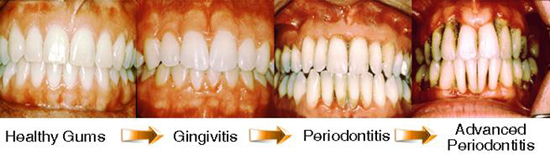
|
Pink and healthy in color No bleeding with pus No swelling teeth
|
Swelling begins
•Gums bleed
•Red discolouration
•Sensitive to touch
|
•Gums recede
Teeth loosen
|
•Halitosis Pockets
filled Loss of
|
Some rare forms of gingivitis are:
- Acute necrotizing ulcerative gingivitis also called trench mouth or Vincent's infection.
- Desquamative gingivitis, a disease primarily afflicting postmenopausal women.
- Gingivostomatisis are painful ulcers on gums and oral mucosa caused by herpes simplex
virus.
- Pericoronitis is inflammation of gums around wisdom tooth.
Periodontitis
Periodontitis (also called periodontal or gum disease) is a bacterial infection
that destroys the supporting structures that hold your teeth in place. Your gums
are the first line of defense against bacterial infection, but once the infection
has broken through them it will begin to attack the ligaments and bone that hold
the teeth in the mouth. The gums draw back and the roots of the teeth are exposed.
It is in this stage of periodontitis that loss of bone due to bacterial erosion
can occur, which will then cause the pocket (space between the gum and tooth) to
grow deeper and wider. Pus develops between the teeth and the gums or the permanent
teeth become loose in their sockets. Left untreated, this disease can lead to costly
and painful procedures such as gum grafts, bone grafts, and ultimately tooth loss.Gum
disease may start as early as adolescence, though periodontitis is more common after
the age of 30. If left untouched it worsens with age. Periodontitis appears and
disappears randomly in different areas of the mouth.
Signs
Periodontitis is often a silent disease as those who suffer from it rarely experience
pain, and may not even be aware that there is a problem. The early stages of gum
disease are seldom painful and carry with them very few warning signs. Some of the
early warnings to look for are slight bleeding while brushing, softening of the
gums and discolouration of the gums (darker red/irritated in appearance rather than
a light, healthy pink). As the disease progresses, more noticeable signs may become
more predominant. Some examples of these more serious indicators are swollen gums,
sores in the mouth, inflamed gums, bright red or purple gums, receding gums that
make your teeth look longer, spaces developing between teeth, loose teeth, pus between
the teeth and gum line (pyorrhea), chronic bad breath (halitosis) and tender gums
when touched.
Dangers
It is estimated that 85% of the population has some form of gum disease.
It has been a long held belief that periodontal disease was just a dental disease,
affecting only the teeth and gums. While it's true that periodontal disease may
originate in the mouth, it is now known that periodontitis is a very serious disease,
affecting the entire body and increasing risk of numerous other adverse health effects
including increased risk of heart attack by as much as 25%, pancreatic cancer, increased
risk of stroke by a factor of 10, problems controlling both type I and type II diabetes,
underweight newborns, respiratory disease and digestive disorders. Periodontitis
is not something to be taken lightly. If you have it, you need to do all you can
to get rid of it.
Cause
The overgrowth of bacteria is the main cause of periodontal disease. One drop of
human saliva can easily contain 50 to 100 million bacteria and a diseased mouth
can contain bacteria into the billions. As bacteria grow, they accumulate (both
dead and alive) and form a sticky, nearly invisible layer called plaqueAs
plaque grows, it appears as a whitish- gray colour. Usually, the formation of this
plaque is along the teeth and gum line. If this plaque continues to grow unchecked,
it becomes calcified and turns into tartar (also known as calculus). Calculus builds
a wedge between the tooth and gum line, and can cause openings called pocketsPockets
are measured by how deep they are from the gum line. Stage 1 periodontitis (called
gingivitis) is 2-3mm deep, stage 2 periodontitis is 4-5mm, and stage 3 periodontitis
is 6mm and deeper.
As the gum tissue comes into contact with the spreading plaque and calculus, the
infection intensifies. Swelling and redness/irritation begin, the
gums become weakened, and bleeding can occur. Once bleeding has started,
the bacteria get an additional source of food and can begin to multiply at an alarming
rate.
As bacteria continue to multiply, they eat. The waste that is produced by bacteria
is highly acidic. So much so in fact that it can eat right through tooth enamel
to the dentin and cause cavities. These bacteria like to hide between
the teeth, on the back of the tongue and especially in the pockets under the gum
line where normal brushing will not disturb it. The acidic waste produced by these
bacteria will eat away at the ligaments and bone of the tooth and gum tissue. Eventually,
this will cause the tooth to become weaker and possibly even loose. This waste can
also eat away at gum tissue and cause them to recede or pull away from your teeth.
If not treated, tooth loss is inevitable and at that point you are exposed to a
whole host of other diseases that are now linked to periodontitis.
Besides the overgrowth of bad bacteria, the following factors may also affect the
health of your gums smoking/tobacco use, medications, genetics, clenching or grinding
your teeth, pregnancy/puberty, diabetes, hormonal changes in women, poor nutrition
and stress.
Periodontitis occurs in several forms. The most common is chronic adult periodontitis.
One rare type advances rapidly and doesn't respond to treatment. Two other forms
of periodontitis are pre- pubertal and juvenile which affects children and teenagers.
These are linked to systemic disorder or family history of periodontal disease.
Treatment can be Scaling and Root Planing
This is a procedure performed by a dentist to keep your gums healthy and firm. Scaling
involves removal of infected deposits like plaque, calculus and stains from the
surface of teeth. While root planing removes roughened cementum and surface dentin
that is impregnated with calculus, microorganisms and their toxins.
The procedures are also known as conventional periodontal therapy or non-surgical
periodontal therapy. The instruments used include ultrasonic instruments, periodontal
scalers and curettes.
|