|
|
|
|
|
|
Back
AIDS & Dentistry
|
HIV reflects in mouth |
|
This information is for people who have mouth (oral) problems related to HIV infection.
It explains the most common oral problems linked to HIV, describes where in the
mouth they occur and how they are treated.
Oral problems are very common in people with HIV because of their weakened immune
system. And even though combination antiretroviral therapy has made some oral problems
less common, others are occurring more often with this type of treatment.
The individual experiences difficulty in chewing or swallowing food reducing his/her
intake of food. This paves the way for other critical health problems.
You may be told that oral problems are minor compared to your main disease. Oral
problems can lead to trouble with eating. If mouth pain or tenderness makes it difficult
to chew and swallow or if you can’t taste food as well as you used to, you may not
eat enough. And, your doctor may tell you to eat more than normal so your body has
enough energy to deal with HIV.
The most common oral problems linked with HIV can be treated. So talk with your
doctor or dentist about what treatment might work for you.
Most common oral problems
|
Picx |
Description |
It could be: |
What & where? |
Painful?
|
Contagious? |
Treatment |
 |
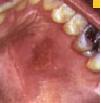
Red sores ulcers |
Aphthous (AF- thus) ulcers. Also known as Canker Sores |
Red sores that have a yellow- gray film on top. They are usually on the moveable
parts of the mouth such as the tongue or inside of the cheeks and lips. |
Yes |
No |
Mild cases – Over-the- counter cream or prescription mouthwash that contains corticosteroids;
More severe cases – corticosteroids in a pill form |
|
|
|
Yes |
|
|
|
|
 |
|
Herpes (HER- peez) A viral infection |
Red sores usually on the roof of the mouth. They are sometimes on the outside of
the lips, where they are called fever blisters. |
Sometimes |
Yes |
Prescription pill can reduce healing time and frequency of outbreaks. |
 |
White hairlike growth |
Hairy Leukoplakia (Loo- ko-PLAY-key- uh) caused by the Epstein-Barr virus |
White patches that do not wipe away; sometimes very thick and “hairlike.” Usually
appear on the side of the tongue or sometimes inside the cheeks and lower lip. |
Not usually |
No |
Mild cases – not usually required; More severe cases – a prescription pill that
may reduce severity of symptoms. In some severe cases, a pain reliever might be
required. |
 |
White creamy or bumpy patches like cottage cheese |
Candidiasis (CAN- di-dye-uh- sis), a fungal (yeast) infection – Also known as thrush |
White or yellowish patches (or can sometimes be red). If wiped may result in redness
or bleeding. They appear anywhere in the mouth. |
Sometimes, a burning feeling |
No |
Mild cases – prescription antifungal lozenge or mouthwash; More severe cases – prescription
antifungal pills. |
 |
Warts |
|
Small, white, gray, or pinkish rough bumps that look like cauliflower. They can
appear inside the lips and on other parts of the mouth. |
Not usually |
Possibly |
Inside the mouth – a doctor can remove them surgically or use “cryosurgery” – a
way of freezing them off; On the lips – a prescription cream that will wear away
the wart. Warts can return after treatment. |
Dry Mouth
Dry mouth is a common problem with HIV infection. Reduction in the supply of sufficient
saliva into the oral cavity leads to dry mouth. Chewing, digestion, protection of
teeth from decay and infections from bacteria and fungi are due to lack of saliva
in mouth. The oral cavity becomes dry, sticky and gives a burning sensation sometimes
followed by chapped lips.
Ready Remedies
- Increase the intake of water and sugarless drinks.
- Avoid tobacco, alcohol,
salty foods.
- Chew sugarless gum or suck sugarless hard candy.
- Use a
humidifier at night.
Talk to your dentist about prescribing artificial saliva to help keep your mouth
moist.
|
|
|
|
|
|